Chemical Conveyor Applications
Chemical conveying is not limited to controlled plants, but also includes fertilizer production, salt handling, and bulk chemical processing, where materials vary from fine powders to coarse granules.
Typical on-site situations include:
- Fertilizer granules and pellets creating uneven loading and particle breakdown
- Sea salt with high moisture and salinity causing corrosion and surface buildup
- Fine chemical powders leading to dust leakage and contamination risks
- Hygroscopic materials forming sticky layers under humid conditions
Key Components in Chemical
Conveyor Idlers
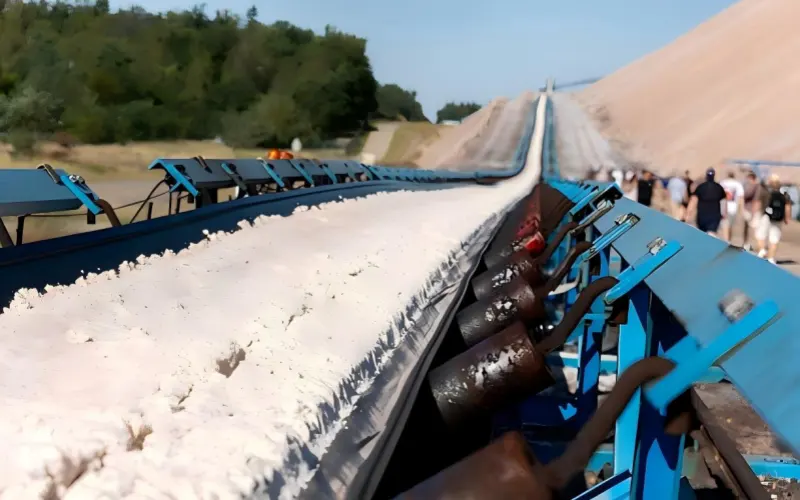
Support the belt when conveying fertilizer granules, salt crystals, or chemical powders, where continuous contact with abrasive or corrosive particles affects long-term rotation stability; in salt or humid environments, moisture and salinity can penetrate sealing and lead to bearing damage or seizure.
- Sealed idlers are recommended in salt handling and powder conveying systems
- Corrosion-resistant structures are important for high-salinity or humid conditions
Conveyor Pulleys
Drive the belt when handling bulk fertilizer, salt, or chemical materials, where uneven particle size and material flow can create localized loading and tension fluctuation; in salt plants, continuous exposure to moisture and salt can gradually affect pulley surface condition.
- Structural stability is important in granular and bulk material conveying lines
- Surface protection is recommended in salt and corrosive environments
Pulley Lagging
Maintains traction when handling moist salt, fertilizer, or fine chemical powders, where material residue and moisture reduce friction between belt and pulley; without lagging, this can result in belt slippage under contaminated surface conditions.
- Strongly recommended in salt plants and humid conveying environments
- Useful in fertilizer systems where material buildup is common
Impact Bed
Absorbs impact where fertilizer granules or bulk salt are loaded onto the belt, especially from hoppers where material flow is uneven or intermittent; repeated loading from coarse particles can cause localized belt stress or indentation.
- Recommended for granular material loading points
- Can be omitted in fine powder or controlled feeding systems
Belt Cleaners
Remove residual material when handling fertilizer, salt, or sticky chemical powders, which often adhere to the belt surface due to moisture or particle breakdown; if not removed, carryback can lead to material accumulation and contamination along return sections.
- Recommended in salt and fertilizer conveying systems
- Multi-stage cleaning for moist or adhesive materials
Selection Notes
- Sea salt (high moisture + salinity) → focus on corrosion resistance and anti-slip performance
- Fertilizer granules → impact and load stability become important
- Fine chemical powders → system sealing and dust control dominate
- Humid environments → higher risk of buildup and carryback